
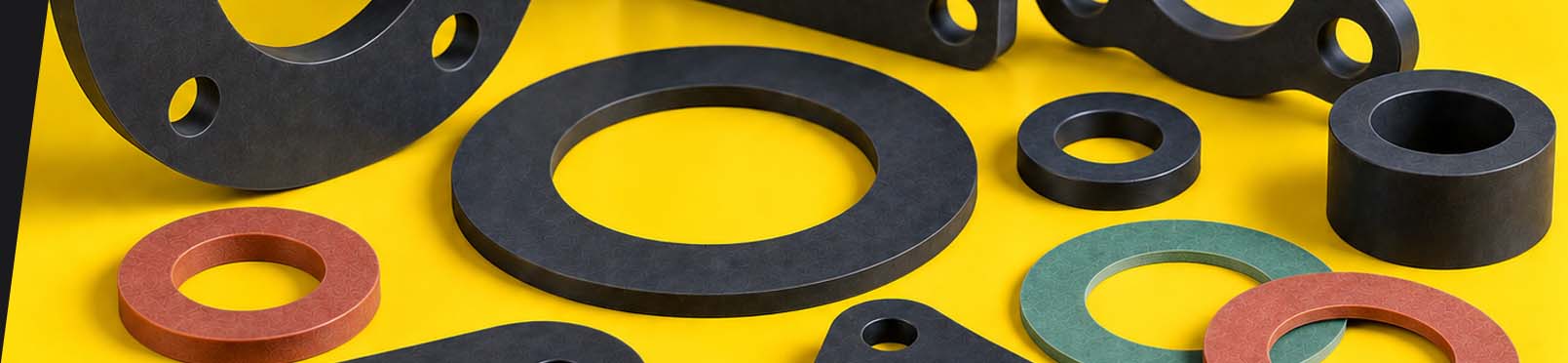
Bluemay Weston manufactures precision rubber gaskets and seals to standard and bespoke specifications for customers across a wide range of industries. Using our punching and water jet cutting capabilities, rubber components can be produced in quantities ranging from prototypes and small development batches through to high-volume production runs.
Rubber is one of the most widely used materials for industrial gaskets and seals because of its flexibility, compressibility and ability to conform to mating surfaces. Bluemay Weston processes a broad range of natural and synthetic rubber grades, enabling material properties to be matched to requirements such as weather resistance, oil and fuel resistance, chemical compatibility, temperature performance and electrical insulation.


Rubber gaskets and seals can be manufactured in circular, rectangular, ring-shaped, frame-shaped and complex profiles to suit individual equipment and assembly requirements. Bluemay Weston produces components to customer drawings, dimensions or samples, allowing apertures, fixing holes, slots and other features to be incorporated within the finished part.
Using precision punching and water jet cutting, we can manufacture anything from prototypes and small development batches through to repeat production quantities. Our broad choice of rubber materials enables bespoke gaskets and seals to be produced with properties appropriate to the mechanical, environmental and chemical requirements of each application.
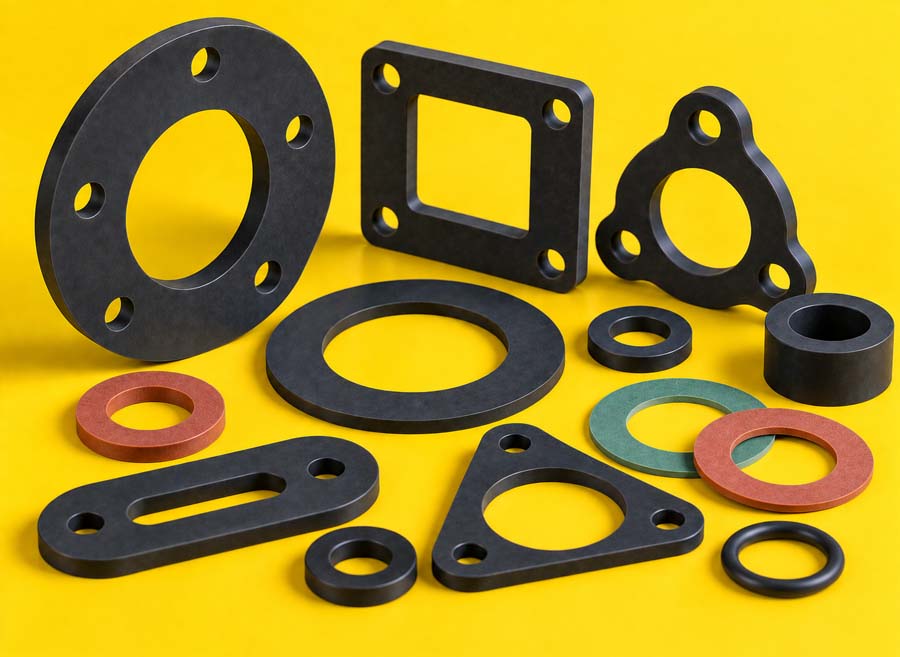
Rubber gaskets provide an effective means of creating a seal between adjoining surfaces. When compressed, the material can accommodate small surface variations and help prevent the passage of air, water, dust, oils, gases or other media, depending upon the rubber compound selected.
Different rubber materials provide considerably different performance characteristics. EPDM is particularly suited to weather, ozone and water exposure, nitrile provides excellent resistance to oils and fuels, neoprene offers a useful balance of weather and oil resistance, whilst silicone and specialist elastomers can be selected for more demanding temperature or environmental requirements.
Rubber also provides useful cushioning, vibration isolation and noise-reduction properties, allowing gaskets and seals to protect components as well as provide environmental or fluid sealing.
Bluemay Weston manufactures rubber gaskets and seals in a wide range of sizes, thicknesses, shapes and configurations. Components can be produced using existing tooling where suitable or manufactured to customer drawings, dimensions, samples and specifications.
Our extensive manufacturing experience enables us to supply rubber gaskets and seals for applications requiring:
Rubber gaskets and seals can also be supplied with self-adhesive backing where required, helping to position and retain components during installation and assembly.
Components are manufactured at our facility in Devon and supplied to customers throughout the UK and worldwide.
Rubber gaskets and seals are commonly manufactured for use in:
Rubber gaskets and seals are used to create flexible barriers between adjoining components and can help prevent the passage of liquids, gases, dust and environmental contaminants.
Typical applications include pumps, valves, pipework, electrical enclosures, automotive assemblies, HVAC equipment, industrial machinery and general engineering equipment.
Rubber is flexible and compressible, allowing it to conform to small variations between mating surfaces when compressed.
This ability to maintain contact across the sealing area makes rubber particularly useful for static gaskets and seals where an effective barrier against fluids, gases or environmental contaminants is required.
Bluemay Weston processes a wide range of natural and synthetic rubber materials including EPDM, nitrile, neoprene, natural rubber, silicone, Viton and other specialist grades.
Different materials provide different characteristics, allowing the rubber to be selected according to the required temperature, chemical resistance, weather exposure, fluid compatibility and mechanical performance.
There is no single rubber material that is best for every gasket application.
EPDM is commonly selected for weather, ozone and water resistance, nitrile for oils and fuels, neoprene for a balance of oil and environmental resistance, and silicone for applications requiring broader temperature performance. Specialist applications may require Viton or another high-performance elastomer.
Many rubber materials provide excellent resistance to water and moisture and can form effective water seals when correctly compressed.
The appropriate rubber compound, gasket dimensions, compression and joint design all influence the performance of the finished seal.
Certain rubber materials provide excellent resistance to oils and fuels, while others are unsuitable.
Nitrile rubber is commonly selected for petroleum-based oils, fuels and greases, whereas EPDM is generally not recommended for these fluids. Material selection should therefore be based on the specific media involved.
Yes, provided an appropriate rubber compound is selected.
Materials such as EPDM offer excellent resistance to weathering, ozone and UV exposure, while some other rubber compounds may deteriorate more quickly when continuously exposed outdoors.
The operating temperature depends upon the type and formulation of rubber selected.
General-purpose and specialist rubber compounds can have significantly different temperature capabilities, so the minimum and maximum operating temperatures should be considered when selecting material for a gasket or seal.
Chemical resistance varies considerably between different rubber compounds.
Some materials perform well with acids, alkalis, oils or industrial fluids, while others may swell, soften or deteriorate when exposed to the same substances. The specific chemical, concentration, temperature and exposure conditions should therefore be considered before selecting a rubber.
Natural rubber provides excellent elasticity, tensile strength and abrasion resistance and can be suitable for many general mechanical applications.
Synthetic rubbers such as EPDM, nitrile, neoprene and silicone are formulated to provide enhanced performance in particular environments, including improved resistance to weathering, oils, fuels, chemicals or temperature extremes.
Yes. Rubber has excellent vibration-isolation and cushioning characteristics.
A rubber gasket can help reduce the transmission of vibration between adjoining components, minimise rattling and protect equipment from mechanical shock as well as provide sealing.
Yes. Many of the rubber materials processed by Bluemay Weston can be supplied with self-adhesive backing.
Low-tack adhesives can assist with temporary positioning during assembly, while higher-tack adhesive systems can be used where a stronger bond to the adjoining surface is required.
Yes. Bluemay Weston manufactures bespoke rubber gaskets and seals to customer drawings, dimensions, samples and specifications.
Components can be produced as simple rings and rectangular gaskets as well as complex profiles incorporating apertures, fixing holes, slots and other features.
Bluemay Weston manufactures rubber gaskets and seals from sheet material using precision punching and water jet cutting techniques.
Punching provides an efficient manufacturing method for suitable repeat production quantities, whilst water jet cutting is particularly useful for prototypes, lower-volume production, larger components and complex profiles where dedicated tooling may not be appropriate.
Bluemay Weston can manufacture rubber gaskets and seals in quantities ranging from prototypes and small development batches through to high-volume production runs of many thousands or millions of components, depending on component size, rubber specification and customer requirements.
